Introduction
With nineteen entries, this is the longest of the three Trailblazing English glossaries. Its necessity and length speak to the fact that Conventional English has long ignored, thereby rendering linguistically invisible, those members of society who exist between or beyond the sex and gender binary. TE offers vocabulary that is useful when communicating as, with, and about Nonbinary, Genderfluid, and Queer individuals. Many of its terms pertain to family relationships.
C
Comparent (pl. Comparents): A term that may be used generically to refer to any or all siblings of a person’s parents
(aunt, uncle, or parsi), regardless of sex or gender identity.
Example: Three of my comparents are coming to my graduation tomorrow — Aunt Marion, Uncle Bob, and Parsi Glen.
“Comparent” combines the Latin prefix com- (meaning “with” or “in association”) and “parent.” (Also see entry for Parsi below.)

G
Ge, Ger, Gers, Gerself: A GEneral third person singular pronoun set that can be used by and for anyone. Related to the French noun gens and Spanish gente, meaning “people,” the etymology of these pronouns can be traced back to Proto-Indo-European gene-, which also provides the root of many English words, including genealogy, genetics, genus, genotype, and general. (See link below.)
gene — https://www.etymonline.com/word/*gene-#etymonline_v_52600
Gex: A new method of self-identification that consists of the merger of Gender and Sex into a unified whole, expressed as
“Gender + Sex = Gex”
A person’s Gex is written as two upper-case letters:
- The first letter denotes a person’s self-identified gender: A (agender),
B (bigender),
F (feminine),
G (genderfluid),
M (masculine),
N (neutrois),
Q (queer), or
S (synthois).
- The second letter denotes a person’s genital structure at birth:
X (from XX),
Y (from XY),
O (from XO) and I (for Intersex) are also possible if the person so chooses.

Some commonly held Gexes are:
FX (cisgender wenn)
MY (cisgender man)
FY (transgender wenn)
MX (transgender man)
BX or BY (bigender person)
GX or GY (genderfluid person or ren)
NX or NY (neutrois person or ren)
SX or SY (synthois person or ren)
QX or QY (queer person or ren)
(See the entry for Ren below.)
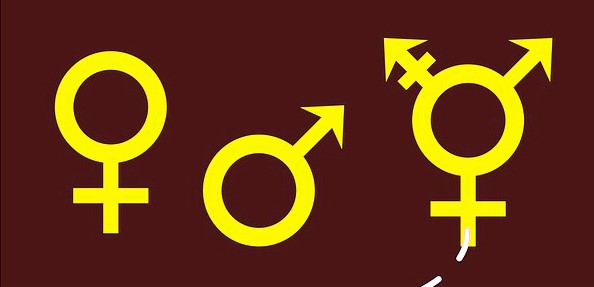
Gexual Category: One of three large categories that a person may choose to identify with according to their gex. The three gexual categories are Wenn, Man, and Ren.
J
Ja or Ja-Ja: [jă or jă-jă] A slang expression for one’s nonbinary parent. (See entry for Jather below.)
Jather: [jă’ ther] A GAIN term for a genderfluid, nonbinary, or queer parent. From Sanskrit janayati, whose meaning can be translated into several terms associated with parenthood, including “generate,” “beget,” and “give birth to.” (See listings from the Sanskirt Dictionary below.)
M
Mrg.: An abbrevation of “Merger,” which can be used as an honorific title by those genderfluid people who can “merge”
their individual genders into one synthesized uber gender.
(See “Synthois” below.)

Mx.: An abbreviation of “Mix,” used as a title by many nonbinary, queer, or genderfluid people.
N
Neutrois: Term for a neuter gender identity.

Nibling(s): An umbrella term for the child of one’s sibling. A nibling can be a niece, a nephew, or a child whose gender identity is between or beyond the binary.


Nxr.: An abbreviation of “Nixer.” Nxr. is an honorific that may be used instead of Ms., Mr., or Mx. by those who identify as neutrois (i.e., no gender) or who “nix” the entire idea of honorifics that reveal any private information about an individual’s sex, (a)gender identity, or marital status.
P
Parsi: / ˈpɛər see / plural parsis / ˈpɛər seez / A title for a comparent (see “comparent” entry) who does not identify as either a wenn or a man.
Example: I’m so happy that Aunt Marion, Uncle Bob, and Parsi Glen are coming to my graduation tomorrow!

The title “parsi” combines the
“p-a-r” of parent and the “s-i” of “sibling” to form a word that expresses the meaning “parent’s sibling.” Having the unique title “Parsi” also signals that a parent’s gender-variant sibling is on a “par” with a cisgender aunt and uncle.
As with “Aunt” and “Uncle,” the title “Parsi” can be given to an actual sibling, sibling-in-law, or good friend of one’s parent.
R
Ren: A noun that may be used as an umbrella term for someone who experiences their gender as being different from, beyond, or between that of wenn and man. It may include genderfluid, gender-gifted, neutrois, synthois, nonbinary, and queer identities.

Ren can also be used as the convenient second element in compound words relating to a gender-variant person, as in chairren, congressren, horseren, etc.
There are three etymologies for “ren.” The first is “renegade” as in “gender renegade.” The second is “renaissance.” The third is Mandarin Chinese rén, which is the gender neutral word for “person.” (See link below.)
ren – https://dictionary.hantrainerpro.com/chinese-english/translation-ren_person.htm
S
Ser: / sɛər / Ser is a general honorific that may be used for getting a stranger’s attention in a public place. Nonbinary teachers may also choose to tell their students to use “Ser” instead of “Ms.”, “Miss,” or “Sir” to catch their attention in classroom settings. The etymology of this title in Trailblazing English comes from the gender-neutral Spanish noun “ser,” meaning a “being,” as in a humin being. However, independent of and etymologically unrelated to the Trailblazing English use of the term, fantasy writer George R.R. Martin has used “Ser” in his Ice and Fire series as the title for his knights of any genders, such as Ser Jamie Lanister and Ser Brianne of Tarth.
Spouse: The term used most often in Trailblazing English for any married person.

Spouseren: A married ren. Used when necessary to indicate that a spouse is a ren.

Synthois: Term for an über gender identity that synthesizes two or more of a genderfluid person’s individual genders into a unified whole.
T
They, Their, Theirs, Them, Themself, Themselves: Trailblazer English endorses the “Singular They” as a GAIN third-person pronoun set for use when a speaker is referring to anyone generally or when a particular person is talking about themself.
For more on the growing acceptance of “Singular They” use for specific individuals and the reclaiming — Yes, the reclaiming! — of its use in the generic sense, see the links to two English language authorities below:
The Oxford English Dictionary – A brief history of singular they – https://www.oed.com/discover/a-brief-history-of-singular-they
MLA Style Center – https://style.mla.org/using-singular-they/?gclid=CjwKCAiA-8SdBhBGEiwAWdgtcJvmqK4w5kDEv3DpMWTSoFBnnYCu-9qIoCq_BUqNlaRuot3kWkRBOhoCRaQQAvD_BwE
Y

Yong: (Yōng) – Meaning “harmony” in Mandarin and Cantonese Chinese, Yong can be used by Gender-variant people to name the space they occupy between or beyond that of Feminine Yin and Masculine Yang.
Yong – 雍 –http://www.cantonese.sheik.co.uk/dictionary/characters/8797/
 Stage Pagan